What are Claude Fable 5.2 and Mythos 5.2?
On 9 November 2026 Anthropic released Claude Fable 5.2 and Claude Mythos 5.2. They are the same model with two levels of access. According to Anthropic they improve on code, reasoning and reading images and charts, and they write answers up to 30% faster than the 5.1 versions.
Fable has strong cybersecurity and biology filters, which is why it is open to everyone. When a request hits those filters, an older Opus model answers instead. Mythos has no such filters. Only organisations admitted to the verification programmes for cybersecurity and life sciences can use it. Claude Enterprise customers also get it inside Claude Security, the service that scans code for flaws.
How much do they cost?
You pay per token, meaning small pieces of text read and written. Fable 5.2 and Mythos 5.2 cost $8 per million input tokens and $40 per million output tokens, 20% less than the 5.1 versions. There is also a fast mode, up to 2.5 times quicker, at double the price.
- Fable 5.2 and Mythos 5.2, $8 in and $40 out per million tokens.
- Fast mode, $16 in and $80 out. For Mythos it is reserved for members of the verification programmes.
- Opus 5.5, the model Anthropic recommends for everyday work, $4 in and $20 out.
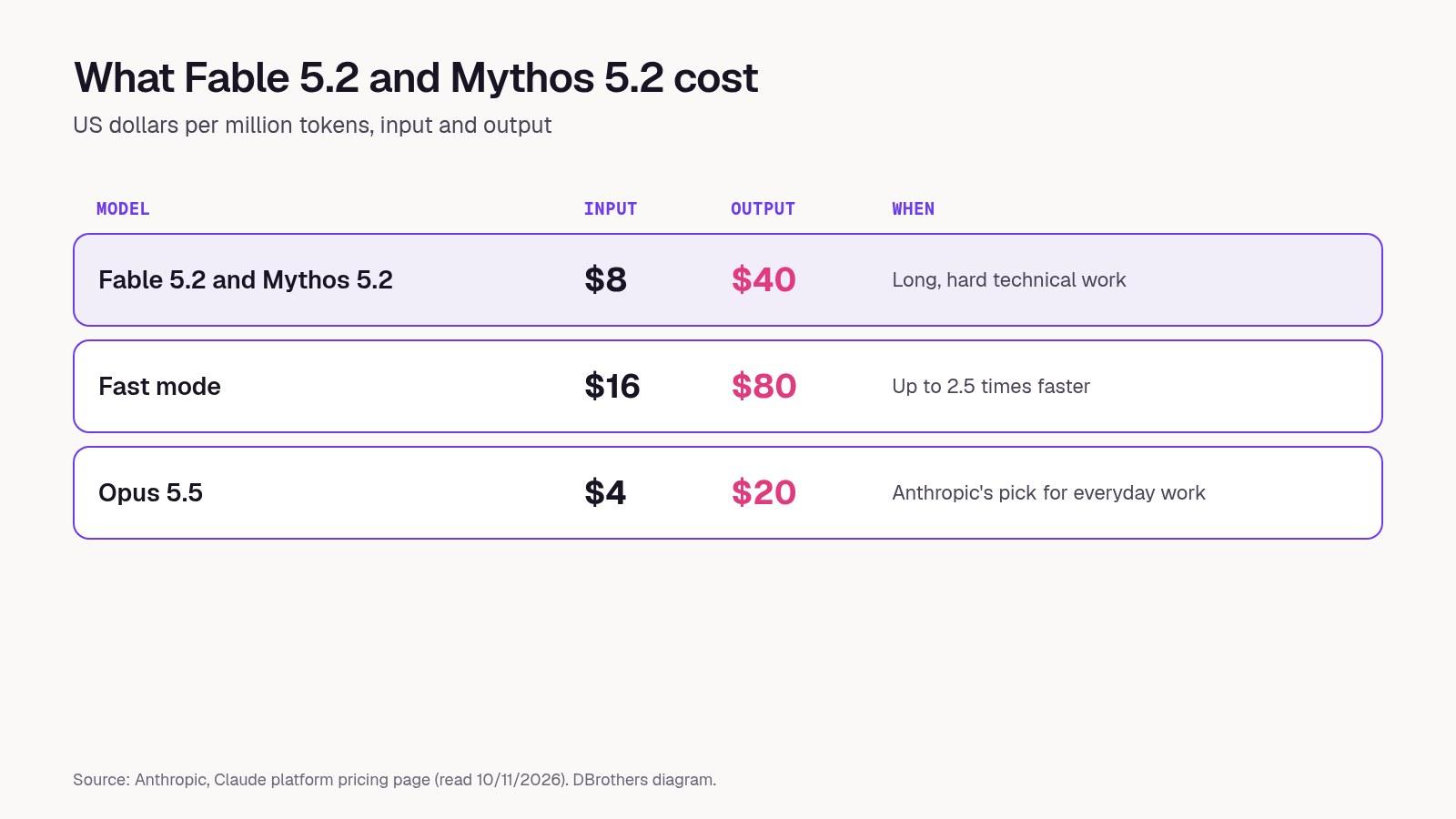
So Fable costs twice as much as Opus 5.5 for the same amount of text. The price list is not the whole story. On one coding test, Anthropic writes, Fable 5.2 matches Opus 5.5's best score at roughly half the cost per task. That is the company's own figure, on a single test.
What is it for, in a business?
Anthropic is clear about it. For most work on code and documents you start with Opus 5.5, and move up to Fable only for the most ambitious, open-ended tasks. An email to summarise or an invoice to read does not need it.
- Migrating an old business system, with a lot of code to read, rewrite and test. Anthropic says a team of agents running an early version of Fable 5.2 moved one of its own production services to another programming language.
- Heavy analysis across many documents. A tester quoted by Anthropic says that, while reading the files of a loan application, Fable noticed that the salary deposits did not match the bank statement balance.
- Advising smaller models. Fable can act as the senior colleague that Opus, Sonnet or Haiku consult on hard steps.
What should you check on data?
For its most powerful models Anthropic monitors usage across many requests, to catch misuse that a single request would not show. Eligible customers can keep zero data retention. For everyone else, Anthropic writes, data is kept for 30 days for this monitoring. If your agent handles customer or staff files, ask which group you are in before you start.
What about us?
Anthropic is one of the model providers we build with, as our Partners page says. In our systems the model can be swapped without touching the rest, because Claude, ChatGPT and local models go through the same door.
How we would use Fable 5.2: we would keep Opus as the base and send Fable only the tasks Opus gets wrong, such as reconciling long documents. Then we would compare the cost per finished task on 50 real cases, not the price per million.
So what should you do?
- If your agent reads emails, invoices or forms, stay on Opus 5.5 or a smaller model. Fable would cost more and give you nothing extra.
- If you have a long technical job that never gets finished today, such as a migration or an analysis of hundreds of documents, try Fable on a case you have already closed and compare the cost per task.
- If you work in cybersecurity or biomedical research, consider applying for Mythos through Anthropic's verification programmes.
“The most expensive model only pays off where the everyday one stops. Measure it on the finished task, not on the price list.”
DBrothers — on choosing the model for an agent
Frequently asked questions
What is the difference between Fable and Mythos?
None in the model. The filters differ. Fable blocks most cybersecurity and biology requests and Mythos does not, which is why Mythos is limited to verified organisations.
Where can you use it?
Fable 5.2 is available in the Claude apps, on the developer platform and on the Amazon, Google and Microsoft clouds.
Should you switch from Opus to Fable now?
For most work, no, and Anthropic itself advises starting with Opus 5.5. Fable pays off on long, open-ended tasks that Opus cannot finish.
Think of the technical job you have been putting off for months because it costs too much by hand. If you want to know whether Fable 5.2 can finish it at a sensible cost, we can start from a case you have already solved and talk it through in 30 minutes.