What happened at Uber?
In August the Dutch Data Protection Authority fined Uber 824,990,000 euros. According to the Authority, software automatically suspended drivers' accounts when it suspected fraud or when customer ratings were too low. After repeated low ratings, the account was closed. No person looked at the case first, and drivers lost their income from one day to the next.
The investigation started from a complaint by 171 French drivers. Uber has stopped the practice but has appealed, so the fine is not final. In similar cases the Amsterdam Court of Appeal had already sided with some drivers. The judges found that Uber had not shown its staff's review was more than a symbolic gesture.
What does decree 179 say about decisions on workers?
Legislative Decree 179 of 2026 was published in Italy's Official Gazette in early October. It aligns Italian law with the AI Act, the EU regulation on artificial intelligence. Article 41 covers employers who use AI systems in decisions about the employment relationship.
- Final decisions on hiring, changing or ending the relationship cannot rest solely on automated processing. The rule also covers disciplinary measures and performance reviews.
- The final decision belongs to a person with real and independent power.
- The worker's consent is not enough to make an exception.
- A dismissal or any other decision taken in breach of these rules is void.
One exception matters for hiring. Searching for candidates and screening CVs are not final decisions, even when a candidate is dropped from the next stages. EU privacy rules still apply, though. And under the AI Act, software that filters candidates is still a high-risk system.
What must you tell your staff?
Before using these systems you must give workers the notice required by article 1-bis of Italy's Transparency Decree, which decree 179 refers to. The notice says which parts of the job the system affects, what it is for, how it works, which data it uses and what checks apply to its decisions.
Decree 179 also grants a right. A worker can ask a person to explain the decision in plain terms, saying how much AI weighed in and which main parameters it looked at. Picture software that flags a drop in productivity, followed by a written warning. The employee can ask who decided the warning and on what basis.
Another article, number 42, brings AI into health and safety. If a system affects how work is organised, its pace or decisions that touch safety, it must be covered in the risk assessment. Workers must be informed and trained on those risks.
What can software do, and what must a person decide?
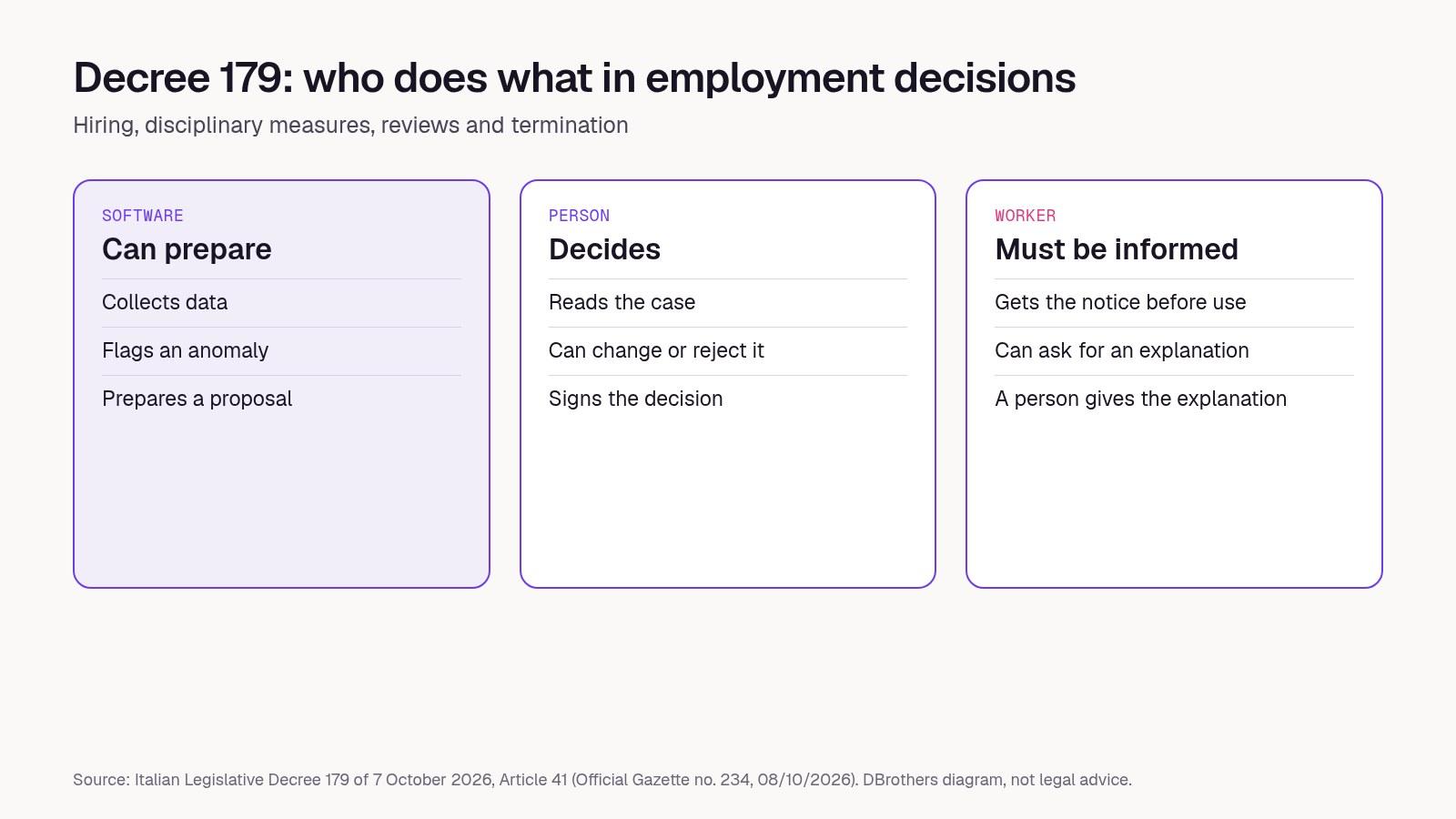
Our read: software can collect data, flag an anomaly and prepare a proposal. The person reads the case, can change or reject it, and signs. If whoever approves always confirms without looking at the data, the Amsterdam ruling suggests that check may not count.
Think of a warning for lateness flagged by the attendance system or an annual review built on figures from the management software. Software can propose; the decision needs a person's name.
What about people who work through an app?
For digital platforms, such as delivery and ride-hailing, there is one more rule. The EU directive on platform work says that a decision to restrict, suspend or close a worker's account must be taken by a person. That person must have the competence and authority to override the automated decision.
The deadline to apply it in Italy is 2 December 2026. The government approved the implementing decree in late October, but the text is not yet in the Official Gazette. This may change; we will update this page.
Where do you start, in practice?
- List the software that touches people: hiring, shifts, attendance, reviews, quality checks. For each one, write down what it proposes and who decides.
- For every final decision, name who can change it, and record who decided and why.
- Ask the supplier how the system works and which parameters it uses. You need them for the notice and for explanations.
- Update the notice to staff and prepare the answer for anyone who asks for an explanation.
- Take the list to your employment adviser, your lawyer and your health and safety officer.
What about us?
On the page of our shift-scheduling agent we say every change is logged and anything that breaks a rule or needs judgement goes to a manager. On our Security page we say sensitive actions wait for a person with full context.
Here is how we would use it with you. Warnings, reviews and contract changes stay out of the automatic actions. The agent prepares the case with the data, a person decides, and the log keeps the name of whoever decided. That is the record you need if an employee asks for an explanation.
So what do you do?
- If the software only prepares data or proposals, write down who decides and keep a record of the decision.
- If the software decides on its own about sanctions, reviews or ending the relationship, stop it and put a person before the decision.
- If you use it only to screen CVs, decree 179 does not treat that as a final decision, but check privacy and the AI Act with your lawyer.
“A person who approves without being able to say no is not human oversight.”
DBrothers — on Italy's decree 179 of 2026
Frequently asked questions
Does the decree ban AI in managing staff?
No. It bans final decisions taken by software alone. AI can prepare analysis and proposals, as long as a person decides and workers are informed.
What happens if software decides a dismissal?
Under the decree it is void, like other decisions taken without a person deciding. The consequences in a specific case need a lawyer's assessment.
Is the employee's consent enough?
No. The decree says the worker's consent is not an exception.
This article explains the law and does not replace advice from your lawyer or employment adviser.
If you use software that rates or manages people, start from one process, such as shifts or annual reviews. We can look at it together and mark where a human decision is needed.