How do Claude's smart reports measure enterprise AI spend?
On 28 October 2026 Anthropic made smart reports available for Claude Enterprise, the business version of its assistant. An admin picks a team, a period of up to 28 days and the products to include. Claude reads a sample of the team's conversations, groups them by type of work and shows what each group costs.
The report also shows what was produced, where work got stuck, and which repeated tasks are worth turning into shared procedures for the whole team. A typical blocker is a missing connection to a business application. Each organisation can run 10 a month at no extra charge. The reports come with shared monthly budgets per group, and admins get alerts as spending rises.
The day before, Salesforce had announced new features for Agent Fabric, its system for managing agents built on different platforms. They include a spending dashboard with hard limits that stop requests before costs go over budget.
Why are companies looking for these numbers?
Because spending is growing faster than plans. TechCrunch reports data from Jellyfish, a company that makes tools for software teams. Spending on AI coding tools has grown tenfold since the start of the year and now equals about 2% of those teams' total cost. Jellyfish's chief scientist said it is growth most finance directors did not plan for.
Our read: knowing what you spend is the first step. The real question is what you get for it, and a total on the bill does not answer that.
Where is the risk for your staff?
To do the maths, the report reads a sample of conversations. Mashable noted that under "inefficiencies" the report also counts personal or off-topic sessions, with their cost. According to Anthropic's guide, these appear only as a total, with no summaries and no names.
For other sessions, names can appear. A setting, off by default, lets report viewers reveal who ran each session, and every reveal is logged. Anthropic says the reports should not be used to evaluate individual performance or make employment decisions. They also refuse questions about health, union activity, religion or private life.
In Italy there is an extra rule. Article 4 of the Workers' Statute covers tools that also make it possible to monitor workers' activity remotely. They may be used only for organisational and production needs, safety or protecting company assets, and as a rule need a union agreement or approval from the labour inspectorate.
The rule exempts the tools employees use to do their work, and it is not certain that a report on chats falls under that exemption. Either way, the data can only be used if workers have been told how the tools and the checks work, in line with privacy law.
Our read: a report that reads work chats should be reviewed with your employment adviser and your data protection officer before you switch it on. The closer the report gets to individuals, the more serious the question.
How do you measure AI return without monitoring people?
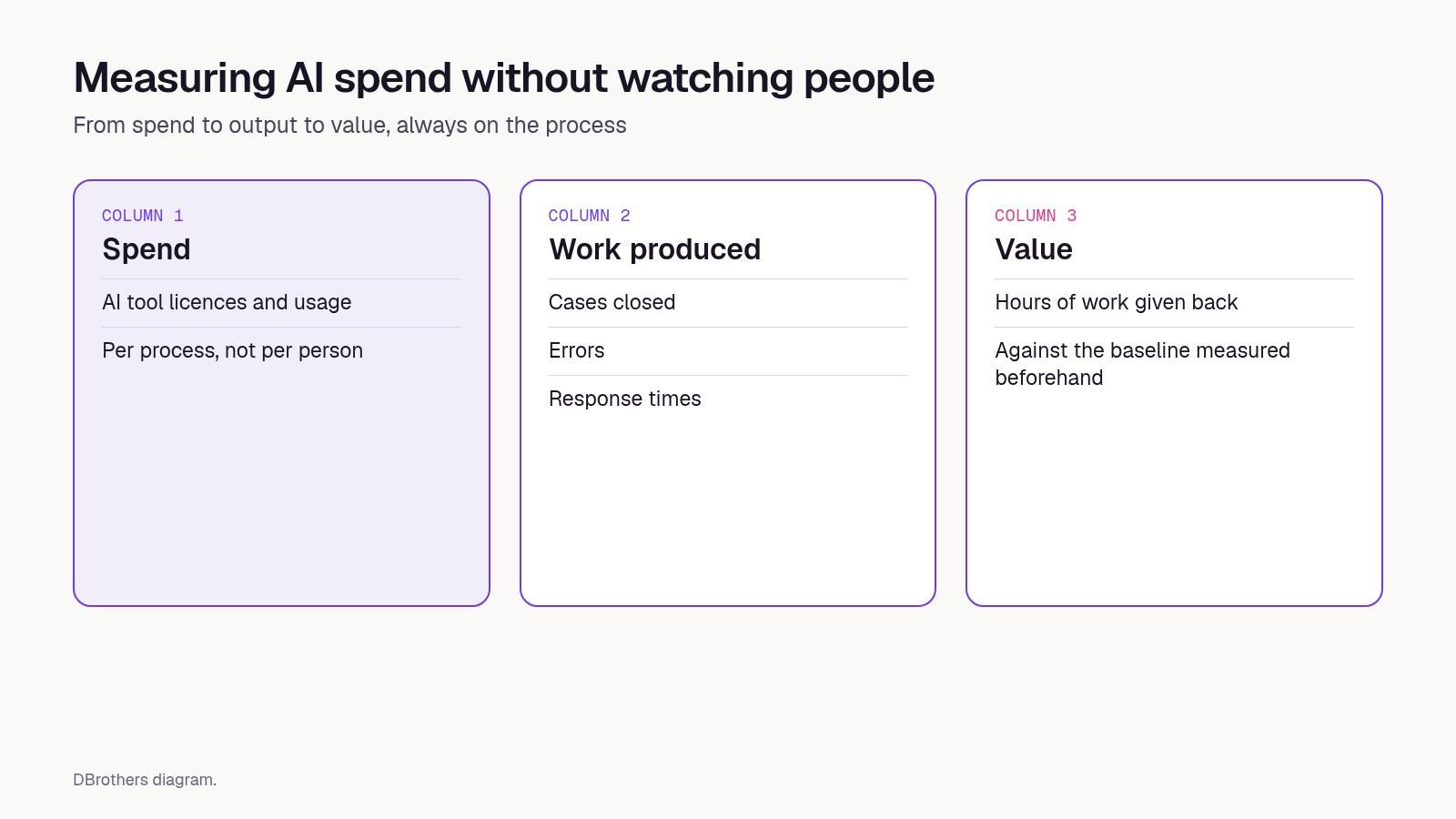
Move the measure from the employee to the process. Take the team that records supplier invoices. The useful questions are what it costs to record one invoice, how many come back with an error and how many days it takes to close the month. Knowing who sent the assistant the most messages says little about value.
- Measure one process at a time, with a before and an after: hours per case, errors, closing times.
- Look at spend per team or per process, not per person. Shared group budgets point the same way.
- Leave individual attribution off, and write down who can turn it on and why.
- Use the report's blockers to fix your tools, not to judge whoever ran into them.
- Tell employees what is read and why, before you start.
What about us?
On our Pricing page we say every engagement starts from a baseline: what a workflow costs you in person-hours today. We size the agent against that number, and after launch we report results against it. It is a measure of the process, not of the people who run it.
So what do you do?
- If you want to know what your AI spend returns, start from a process whose cost in hours you already know.
- If your AI tool offers reports on conversations, involve your employment adviser and data protection officer before turning them on.
- If the report can show names, keep that setting off until you have a written reason and staff have been informed.
“You measure what a task costs and what it returns. Who handled it is not the number to watch.”
DBrothers — how we measure an agent's return
Frequently asked questions
Are smart reports available to everyone?
No. They are for Claude Enterprise, they are off by default and the account owner turns them on. Some special setups, such as customer-managed encryption keys, cannot use them.
Is a spending limit enough to keep costs under control?
It avoids surprises on the invoice, but it does not tell you whether the spend pays off. For that you compare it with what the process cost before AI.
Can I use the reports to decide bonuses or promotions?
Anthropic says they should not be used to evaluate individual performance or make employment decisions. In Italy the Workers' Statute and privacy rules apply on top.
If you want to see what your AI spend returns, we pick one process together and the value measures to track, without turning them into a check on people.