Can an AI agent sort a council's certified email?
Yes, if it proposes and a person confirms. In Italy, citizens and companies write to public bodies by PEC, a certified email with legal value. Sorting it means reading each message, working out what it is about and sending it to the right office. AI can do this repetitive work, and it decides nothing about the citizen.
There is already an Italian precedent. INPS, the national social security institute, classifies and sorts PEC with models trained on the messages and on its staff's corrections. Everything runs in the Institute's own data centres, to stay within GDPR. According to the OECD case study, with figures supplied by INPS for 2022, the system was live in 10 cities and had processed more than one million PEC messages. The Institute estimates it saves 30,000 to 40,000 working days a year.
Our read: these figures are self-reported and not independently checked. They still show you can sort PEC with the data kept in-house.
What does the AI Act say about sorting certified email?
The AI Act lists the high-risk uses, and sorting mail is not on the list. Even when a system works in one of the listed areas, the regulation does not treat it as high-risk if it performs a narrow procedural task and does not profile people. The high-risk rules start on 2 December 2027 in any case.
The AI literacy duty already applies: your staff must be helped to know how to use the system. In Italy, Law 132 of 2025 adds that public bodies must use AI in a way that keeps its workings knowable and its use traceable.
What do GDPR and security require?
PEC messages hold personal data, sometimes special categories, such as a medical certificate attached to an application. For a public body the legal basis is a task in the public interest, as GDPR provides. You need appropriate security, and an impact assessment if the risk to people is high, assessed with your data protection officer.
If your body falls under the NIS cybersecurity rules, as Italian municipalities over 100,000 residents and regional capitals do, the system also comes under those measures. Coordination sits with the digital transition officer that Italy's digital administration code requires.
Denmark offers a good example on data. The Danish Agency for Digital Government tells public authorities that personal data may only go into tools assessed and approved for that data, never into free services open to everyone.
Why do the records rules help?
Italy's rules on electronic records registration are already built for tracked work. Every message received gets a single registration. Under the AgID guidelines on electronic documents, in force since 2022, the subject, sender and recipient cannot be changed. The only details that can change after registration are the internal assignment and the classification.
The records system tracks every operation and attributes it to the officer, keeping both old and new values visible. The assignment rules sit in the records management manual, which the body publishes on its website.
Our read: the agent works on exactly the two fields the system allows to be corrected, and every proposal it makes leaves a trace. The registration remains an operation attributed to a person.
How does it work in practice?
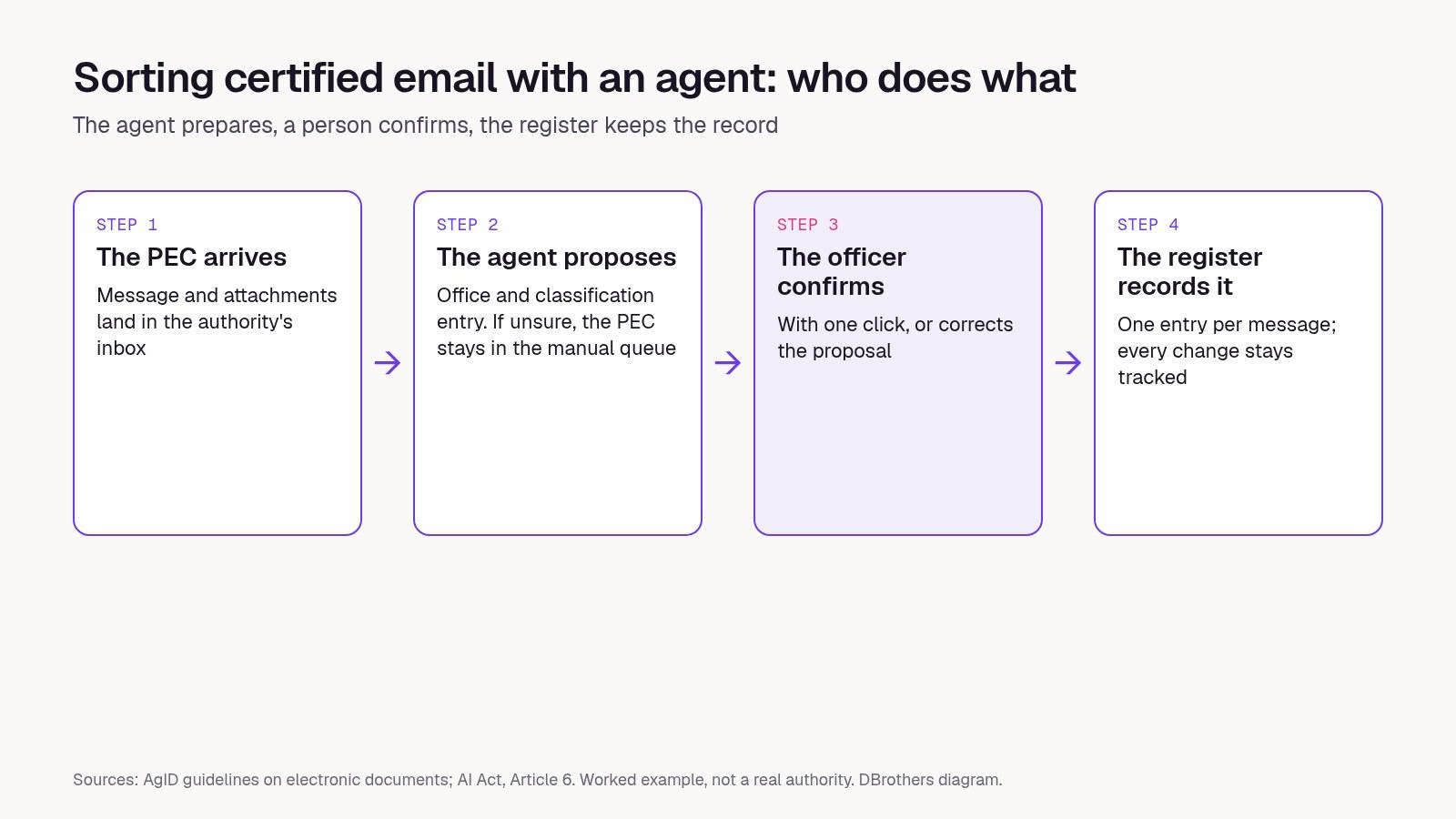
An example case, not a real body. A regional capital receives 600 PEC messages a day. The agent reads each message and its attachments, then proposes the office and the classification entry. The records officer confirms with one click or corrects it. Messages the agent is unsure about stay in the manual queue, as they do today.
- The agent proposes; the records system registers only after the officer confirms.
- Below a confidence threshold set by the body, the message goes straight to a person.
- Every proposal and every correction goes into a log. The records history shows what the agent proposed and what the officer changed.
- Data stays in environments the body has authorised, with no copies on free services.
- The records management manual describes assisted assignment and the officer's role, and is published once updated.
- For four weeks, assignment times are measured before and after, on the same types of message.
What about us?
On our site we describe the Document-Protocol Agent, built for document registration. It classifies and files on the office's rules, sends anything it can't classify with confidence to a person, and logs every action. Our Security page states that sensitive actions wait for a person.
How we would set it up in a municipality: the agent starts with proposals only and registers nothing on its own. The officer keeps the confirmation, and the first weeks are compared with the times from before.
So what should you do?
- If all PEC messages land in one mailbox and someone sorts them by hand, start there: it is the simplest use case.
- If your records system keeps a history of changes, use it to check the agent.
- If messages often contain health data or data about children, involve the data protection officer before the trial.
- If the body falls under NIS, add the agent to the security measures already in place.
“The agent proposes the office, the officer confirms. Registration stays in a person's hands.”
DBrothers — how we would sort a public body's certified email
Frequently asked questions
Is a privacy impact assessment always needed?
GDPR requires one when the processing carries a high risk, for example with a lot of health data. With PEC that is common, so it is better done before the trial than after.
Does the citizen need to know an AI reads their PEC?
Law 132 of 2025 asks for the workings to be knowable and the use traceable. The simplest way is to state it in the records management manual and in the privacy notice.
What happens if the agent picks the wrong office?
Your officer corrects the assignment, as with a human mistake today. The records system keeps both, and the corrections help improve the agent.
If someone in your office spends their mornings sorting PEC, that is the right place to start. We map the assignment rules together, and the confirmation stays with the records officer.