How many European firms use AI, according to the EIB?
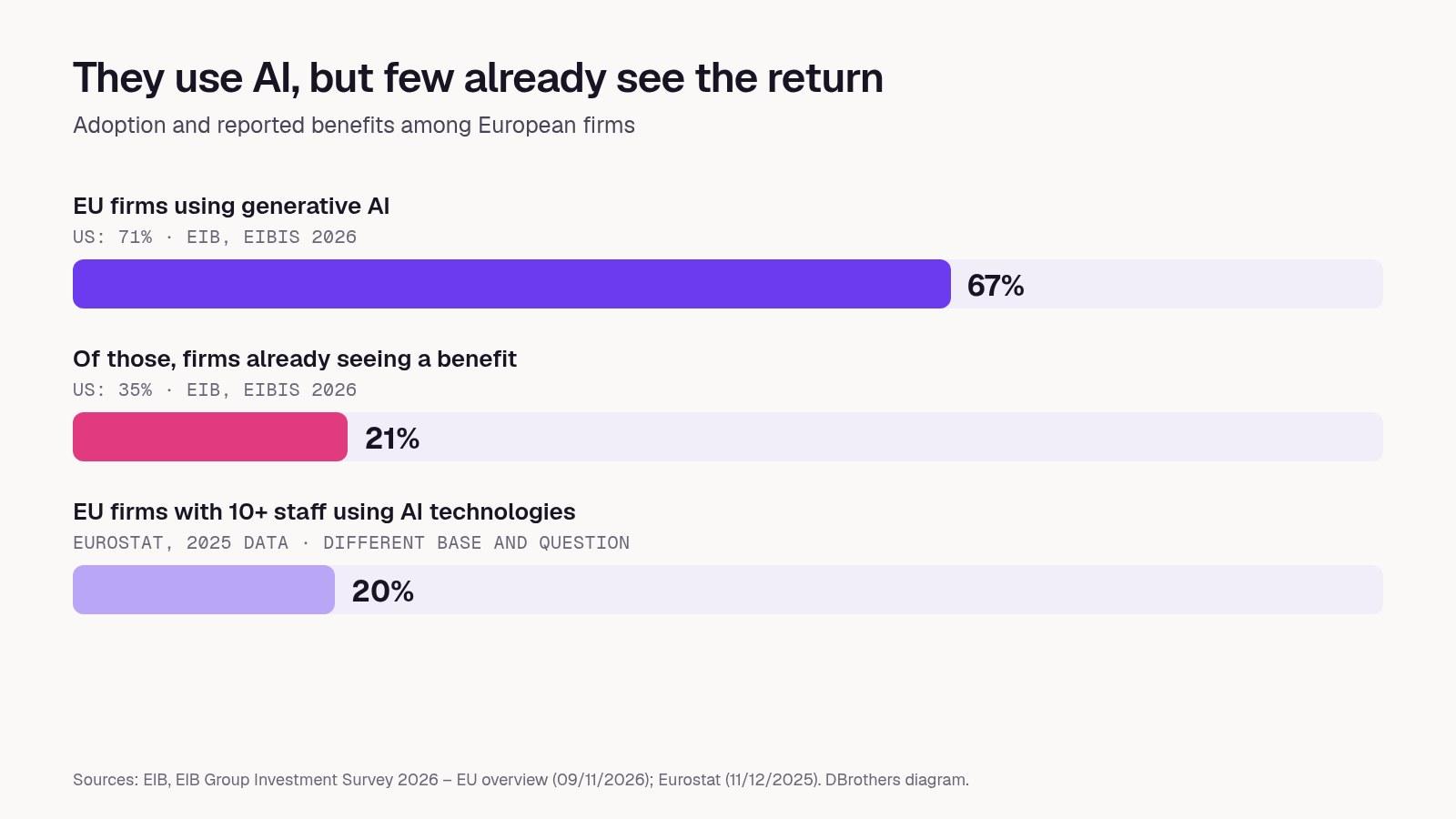
On 9 November 2026 the European Investment Bank (EIB) published its annual investment survey, covering about 12,000 firms in the 27 EU countries and 800 in the United States. 67% of European firms already use generative AI tools, the ones that write text, images or code, such as ChatGPT, Gemini, Claude, Mistral or Copilot. In the United States the share is 71%.
Another 13% plan to start within a year. Among small and medium-sized firms, though, 27% have no plans at all, against 9% of large firms. The EIB names Italy among the countries where adoption is lowest and more firms say they have no plans.
How many already see a gain?
This is where the figures drop. Among EU firms that use generative AI, 21% say they already see benefits, against 35% in the United States. Nearly half expect a gain within two years, and 69% think the biggest advantage will be efficiency in everyday work. Few expect more sales.
Firms that do not use it give two main reasons. 43% say they have no need for it and 28% are unsure of the benefits. Our read: between “we use it” and “it pays” there is a step many firms have not taken yet, which is picking one specific job and measuring it.
Why does Eurostat say 20% and the EIB 67%?
Look for other data and you find very different figures. Eurostat, the EU statistics office, counts 20% of firms with at least 10 employees that used at least one AI technology in 2025. In Italy, according to Istat, the share was 16.4%, double the year before. These are different surveys measuring different things.
- The EIB asks whether a firm makes systematic use of tools such as ChatGPT or Copilot. Eurostat asks about a list of AI technologies, from text analysis to image recognition.
- The EIB weights answers by value added, so large firms count for more. Eurostat counts firms one by one, and small firms are the vast majority.
- Eurostat's figure is for 2025. The EIB collected its answers between April and July 2026, and generative AI has spread fast.
Our read: the 67% describes the firms that weigh most in the European economy, the 20% describes the average firm. For a small Italian business the second figure is closer to reality.
What does it mean for your business?
Take an accounts office where three people use ChatGPT to write emails to customers. In the survey that firm counts as one that uses AI. But nobody knows how much time it saves, so nobody knows whether it pays.
Now think of recording supplier invoices. You count how many minutes each invoice takes today and how many errors come out in a month. Then you try an AI tool on the same job and do the sums again. That is how you know whether you are in the 21% that already see a benefit.
The EIB also points to another front. 64% of EU firms are taking action against economic security risks, such as trade restrictions, cyber threats and dependence on strategic suppliers. 82% invest to defend against cyber attacks. When you choose an AI tool, ask where your data ends up too.
What about us?
On our Pricing page we say that every project starts from a baseline, meaning what a process costs you today in hours of work. We size the agent on that number, and after launch we report results against that baseline.
So what should you do?
- If your team already uses ChatGPT or Copilot, pick one repetitive job and measure the minutes per case before and after.
- If you do not use AI because you see no need, look at the jobs where someone copies data from a document into a business system. That is usually where to start.
- If you already pay for several AI tools and do not know what they return, stop and measure before you buy another one.
“Using AI is easy. Knowing what it returns takes a starting number.”
DBrothers — on the return of AI in business
Frequently asked questions
Who ran the survey?
The European Investment Bank, with the research firm Ipsos. It is the EIBIS, repeated every year since 2016 on about 12,000 European firms.
Does the 67% apply to Italy?
No. It is the EU average. The EIB says Italy is among the countries with the lowest adoption, and Istat counts 16.4% of firms with at least 10 employees using AI.
What counts as a benefit?
It is what the firms report. The gain they expect most is efficiency in daily work, far more than sales.
Pick a task your office does every week and measure how long it takes for 30 days. With that number in hand, we can talk for 30 minutes and see whether an AI agent would make you money.