
What changes for 231 liability with Italy's decree on artificial intelligence?
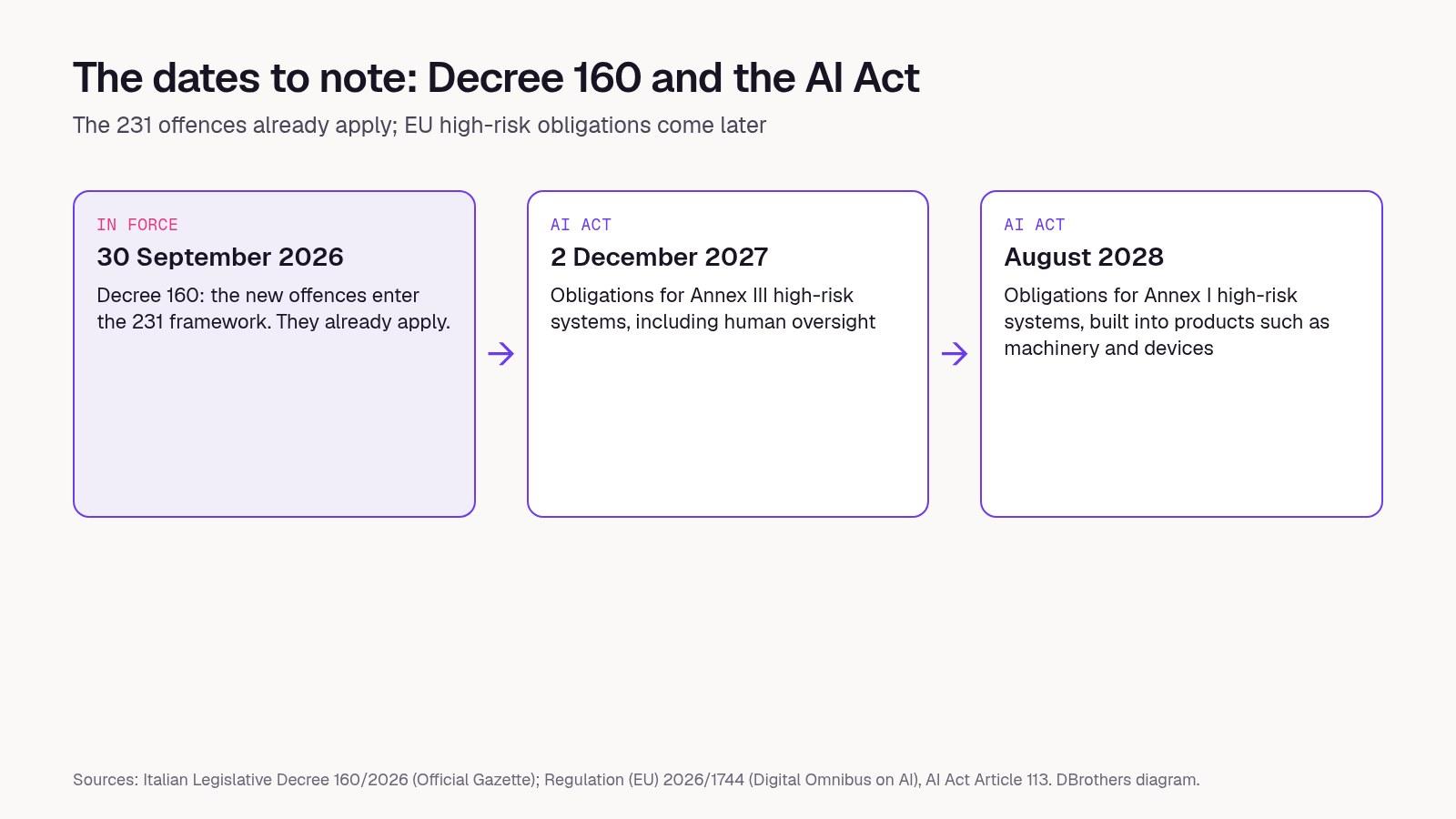
Legislative Decree 160 of 2026 was published in Italy's Official Gazette in September and has been in force since 30 September 2026. It aligns Italian law with the AI Act, the EU regulation on artificial intelligence. For businesses, the main change is new article 25-vicies of Decree 231, which adds two offences committed with AI to the list for which a company can be held liable.
- Failing to adopt safety measures for high-risk AI systems, new article 437-bis of the Criminal Code. For the company the fine ranges from 600 to 1,000 quotas.
- Unlawfully spreading images, video or voices faked with AI, article 612-quater, introduced by Law 132. For the company the fine ranges from 200 to 700 quotas.
- In both cases disqualification penalties can apply too, such as a ban on contracting with public bodies and exclusion from grants and funding.
The general rules of 231 do not change. The company is liable if the offence is committed in its interest or to its advantage, by its managers or by people working under their direction. Decree 231 does not require a company to adopt a compliance model. It does say the company is not liable if it proves, among other conditions, that it adopted and effectively implemented one before the offence.
What does new article 437-bis punish?
The first paragraph covers anyone who designs, trains, produces or places on the market a high-risk AI system without the required safety measures, or without human-oversight measures. It is an offence only if this creates a danger to people's life or safety, or to national security. The penalty is lower if the act is committed through gross negligence.
The last paragraph covers whoever uses the system at work, which the law calls a professional user. They are punished if they deliberately fail to provide human oversight and the same danger follows. It matters most for companies that buy systems built by others.
When is an AI system high-risk?
The AI Act decides, in article 6 and Annexes I and III. Examples are safety components of machinery that needs an outside check, and systems used to run critical infrastructure, select staff or assess access to essential services.
Our read: the offence also needs a danger to life or safety. Software that sorts CVs is high-risk under the AI Act, but it is unlikely to put anyone's physical safety at risk. A system that controls a press on the factory floor or a gas distribution network could. Look at those cases first, with your lawyer.
What do we know, and what is still unclear?
We know the two offences already apply. The EU obligations for high-risk systems, human oversight included, start later. The EU regulation known as the Digital Omnibus moved them to 2 December 2027 for Annex III systems, and to August 2028 for Annex I systems.
What we don't know yet is which technical safety measures the offence refers to in the meantime. According to the Agenda Digitale analysis, this needs to be settled by interpretation. On the civil side, the decree lets a judge in a damages case order the release of the system's logs and of its risk and human-oversight documents. Complying with the AI Act, even with certification, does not by itself rule out liability.
Where do you start, in practice?
- List the AI systems you use, including those built into software you buy. For each one, write down who uses it, for what and with which data.
- For each system, write down whether it is high-risk and why, with the date and the name of whoever assessed it.
- For high-risk systems, name who oversees them, what they check and how they can stop them.
- Ask the supplier for instructions for use, logs and what they do in an incident, and put it in the contract.
- Take the list to your supervisory body and your lawyer, to decide whether to update the risk map and the 231 compliance model.
The Agenda Digitale analysis considers it necessary to update risk assessments and the model right away. That is a lawyer's reading, not an obligation written in the law.
What about the offence on fake content?
It covers anyone who, without consent, spreads content faked with AI that can mislead, causing unjust harm to a person. In a company the typical risk sits in marketing, for example a promotional video using a real person's voice recreated with AI without their consent.
What about us?
Our Security page says every call an agent makes is logged with inputs and outcome, sensitive actions wait for a person, and every change can be reviewed and reversed. That is the evidence a supervisory body needs to see who oversees a system.
Here is how we would use it with you. For each agent we would write down who oversees it and with which permissions, and prepare a summary of the log to hand to your supervisory body at every review.
So what do you do?
- If you use AI only for drafts and summaries, update the list and check how you publish generated content.
- If an AI system touches the safety of people or plants, treat it as high-risk until your lawyer says otherwise, and name who oversees it.
- If your 231 compliance model says nothing about AI, ask your supervisory body whether it needs updating.
“For 231, what counts is being able to show who was overseeing the system, with a name and a log.”
DBrothers — on Italy's Decree 160 of 2026
Frequently asked questions
Does the decree require you to update your 231 model?
No, it doesn't say so. The model remains the defence provided by Decree 231. Without a model that covers the new offences, the company cannot rely on that defence.
Does it apply to small businesses?
Decree 231 applies to companies and associations with no size threshold. The article 437-bis offence, however, only covers high-risk systems and requires a danger to people or to the State.
List the AI systems your company uses today and note who oversees each one. If you like, we can set it up together on one process before you take it to your supervisory body.