What did Istat measure?
Istat, Italy's national statistics office, has published the first results of the third multi-purpose survey in its permanent business census. The sample is about 265,000 firms, representing more than a million businesses with at least 3 staff in industry and services, excluding banks and insurers. The reference year is 2025.
For the first time this survey includes a set of questions on artificial intelligence, built like those of the EU survey on digital technology use. So the figure also covers micro firms with 3 to 9 staff, which make up three in four businesses in the population studied.
How many firms use AI?
That means roughly one in six Italian firms with at least 3 staff uses at least one AI tool. The share grows with size. Istat also finds that use is higher among firms that work in networks with other companies, in every size class.
To do what?
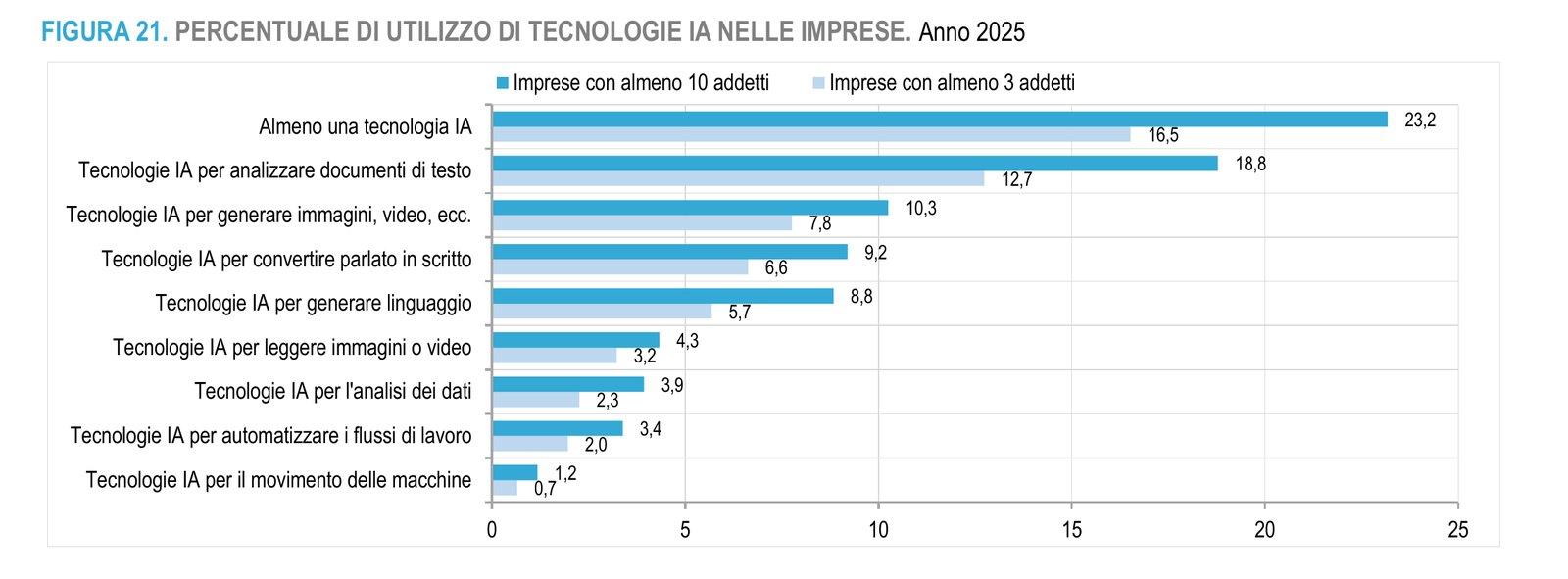
Here are the shares for firms with at least 3 staff, with the figure for firms with at least 10 in brackets.
- Text document analysis, 12.7% (18.8%).
- Image and video generation, 7.8% (10.3%).
- Speech-to-text conversion, 6.6% (9.2%).
- Language generation, meaning text and replies, 5.7% (8.8%).
- Image or video recognition, 3.2% (4.3%).
- Data analysis, 2.3% (3.9%).
- Workflow automation, 2.0% (3.4%).
- Moving machines such as robots and vehicles, 0.7% (1.2%).
What do these numbers tell us?
The top use is reading and summarising text, which is what assistants like ChatGPT do. Istat notes that text analysis has no strong links with the other technologies. It looks like a general-purpose use that says little about the firm's profile.
In our view many firms use AI as a personal tool, one document at a time. Few have built it into a process, such as sorting requests or checking invoices. The 2% that automate workflows is the figure to watch in the coming years.
Where do we stand?
We work right in that 2%, with agents that handle one step of a process while a person approves the unclear cases. Before automating anything we would find the step that costs the most time and the person accountable for it.
What do you do with this data?
- If only a few people in your firm use AI to write or summarise, you are in line with the average. The next step is to pick one repetitive process and measure it.
- If you already have a process with AI inside it, you are in a minority. Keep track of how much time it saves and how many errors it catches.
- If you need to pitch a project to partners or a bank, use the Istat figures as a benchmark for your sector and size, not as a target.
“Using AI on a document is different from having it work inside a process. The census shows how wide that gap still is.”
DBrothers — on the Istat data
FAQ
Why do these figures differ from other AI statistics?
Because they depend on the population. The census counts firms with 3 or more staff, while many other surveys start at 10. That is why Istat publishes both shares.
Is there data by sector and region?
Yes. The report and its statistical appendix give figures by sector, size and area down to province level. Istat says more data will follow in the first half of 2027.
Which firms are left out?
Firms with fewer than 3 staff and those in financial and insurance services. According to Istat, the firms studied are about a fifth of all Italian firms but produce 87.5% of value added.
If you want to work out which process in your business is worth handing to an agent, start with the one that repeats every day and the person who loses the most time on it. We can look at it together.