What is MEPA Light, and what changes for public buyers?
On 29 October, Italy's Ministry of Economy and Finance (MEF) and Consip opened MEPA Light (MEF press release no. 117). It is a new space inside Acquisti in Rete, the national e-procurement portal. It covers direct awards under €5,000, excluding VAT, for goods, services and works. Instead of filling in screens, you describe your need in plain words or upload a supplier's quote. An AI agent, meaning an assistant that doesn't just answer but moves the case forward, guides you to a signed award.
The volume is large. The MEF quotes estimates by ANAC, Italy's anti-corruption and procurement authority. Purchases in this band add up to more than 3 million procedures a year, worth about €5 billion. Think of a school's stationery, the town hall's boiler repair, a training course for the planning office. Small cases, but each with its own tender code, its own documents and its own signature.
How does MEPA Light work, in practice?
Put the MEF press release and the Acquisti in Rete page side by side, and the path looks like this:
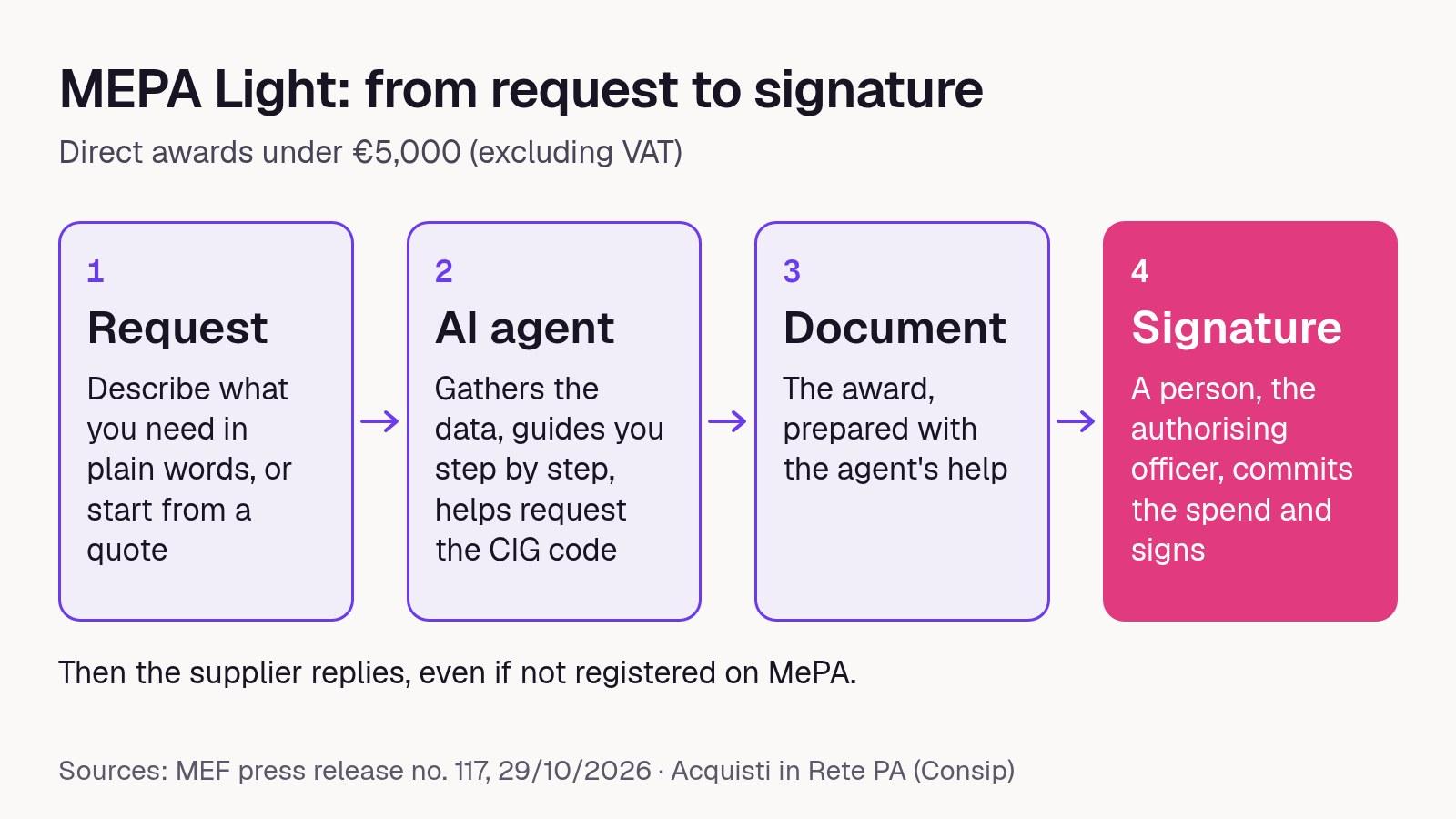
- Describe the need: write what you need in plain language, or start from a document you already have, such as a quote.
- The system retrieves the information it needs on its own and walks you through the rest, step by step.
- Request the CIG, the code that identifies every Italian public procurement procedure, without leaving the same workspace.
- Prepare the award documents with the agent's help.
- Sign and send the award. The supplier replies and the contract closes in the same flow, all of it on record.
Who can use it, and who decides?
To buy on MEPA Light you must be registered on Acquisti in Rete and act for your office as a Punto Ordinante or a Punto Istruttore. Acquisti in Rete explains the roles. The difference matters. The Punto Istruttore prepares and supports. The Punto Ordinante, the authorising officer, commits the body's spend. To be enabled, says the portal's guide to profiles and roles, they need a digital signature. The agent guides; the signature stays with a person.
Consip says the same about its own processes. In its model, artificial intelligence supports people's decisions. DsgaOnline, an association of Italian school administrators that took part in the tests, puts it even more plainly. Assessments, checks and purchase decisions stay with the staff.
What changes for companies that sell to the public sector?
This is the second change, and for a small business perhaps the more concrete one. With MEPA Light, the MEF says, an office can award work to suppliers not yet registered on MePA, Italy's main public e-marketplace. That includes SMEs, start-ups, sole traders and foreign companies. Acquisti in Rete says you can become a public-sector supplier without registering on the e-marketplaces. According to DsgaOnline, the supplier reads the documents received and can accept the award, ask for changes or decline it.
Our read: if you are a plumber, a print shop or a training provider, your quote can become the starting point of the case. The clearer it is about what, how much, when and at what price, the less work is left for the office that has to turn it into an award.
Why does it matter beyond purchasing?
MEPA Light does not come alone. In May, Consip announced 38 AI use cases across the public contract lifecycle. The same plan named the third quarter for the first national framework agreement offering AI solutions to every public body: an announced target, worth checking on Consip's site. Then, in October, it made the final award of a €460 million framework agreement for digital health, data governance and artificial intelligence in Italy's national health service.
Our read: MEPA Light brings into a national public service a pattern that fits many procedures. A person says what is needed, the agent gathers the data and prepares the documents, a person checks and signs, and every step stays on record. The MEF stresses exactly this full traceability. The same pattern fits document registration, case reviews and citizens' requests.
That number doesn't come from an AI agent but from a public-sector project. For the City of Cagliari we built the platform that brings public and private shared-mobility operators together. The lesson holds here too. In a public office, a system works when the office sees everything that happens and the decision stays with it.
What about us?
We don't work on MEPA Light and haven't seen its agent from the inside. But the pattern is the one we use to design agents for public bodies. Take document registration. With the Document-Protocol Agent, a document arrives by certified email (PEC) or regular email. The agent registers, classifies and files it, and anything it can't classify with confidence goes to a person. Approvals and signatures stay with the office, and every action goes into the log.
So what should you do now?
- If your office often buys under €5,000, check who holds the Punto Ordinante or Punto Istruttore profile and try MEPA Light on a simple purchase.
- If your company sells small supplies to Italian public bodies, make your quotes clear and complete: they can become the starting point of the case.
- If your office runs a repetitive procedure outside purchasing, ask which steps an agent could prepare and where a person's signature must stay.
“In a public office, a good agent prepares the case. The signature stays with whoever is accountable for it.”
DBrothers — how we design agents for the public sector
MEPA Light: frequently asked questions
Does MEPA Light replace MePA?
No. It is a new digital marketplace inside Acquisti in Rete, dedicated to direct awards under €5,000 excluding VAT. It sits alongside MePA and the portal's other tools, which remain available.
Does a company have to be registered on MePA to receive an award?
No. Offices can award to suppliers not registered on MePA, including SMEs, start-ups, sole traders and foreign companies, according to the MEF.
Does the AI agent decide the purchase instead of the official?
No. The agent guides and prepares the steps. The spend is committed by the Punto Ordinante, who holds a digital signature. A person chooses, checks and signs.
If your office handles the same procedure every day, that's the place to start: we map the steps together, decide what the agent prepares, and the signature stays with the official.